


:format(webp)/vulcan.abetter.bid%2Fwp-content%2Fuploads%2F2025%2F03%2Ferik-mclean-UlQE9rNwXHQ-unsplash.jpg)
:format(webp)/vulcan.abetter.bid%2Fwp-content%2Fuploads%2F2022%2F10%2F2022-10-05-11.30.40-150x150.jpg)
 FAQ
FAQ 
Auction Tips
September 23, 2022
How to Save Money at a Car Auction
:format(webp)/vulcan.abetter.bid%2Fwp-content%2Fuploads%2F2022%2F10%2F2022-10-05-11.32.26-150x150.jpg)


Customer Service
9 am - 6 pm EDT
Monday - Friday
International
+1 (302) 613 - 1026Toll-Free
+1 (888) 277 - 3182The out-the-door price is the vital factor influencing a car purchase. First, you’ll avoid sticker shock. Second, the out-the-door price implies the total amount you’ll actually pay. Unlike the advertised selling price, the out-the-door price includes all vehicle taxes, fees, and additional costs. Car shoppers would rather focus on this final figure. Analyzing monthly payment offers or the base price of the vehicle is a secondary task.
The out-the-door price is also known as the OTD price. It’s the final amount you’ll pay for a vehicle. This includes the selling price plus all additional fees (registration fees, documentation fees, and dealer add-ons). It represents the entire cost of your purchase before financing. This is the true price to compare when negotiating with different dealerships. Safeguard yourself from hidden fees when signing the new vehicle sales contract.
Calculating your next vehicle’s out-the-door cost is a complex process. The car-buying process is not that simple. You’ll need to add several mandatory government and dealership fees. Along with the down payment, these costs can add thousands to your total cash price during car shopping. Here are they:

Beyond standard taxes and other fees, dealers often include additional charges that inflate the out-the-door price. These might include destination fees, advertising fees, or dealer prep charges. Many of these documented fees are negotiable. When comparing door prices between different dealers, request an itemized breakdown to identify legitimate fees versus those padding the dealer’s profit.
Many dealerships try to increase your out-the-door cost. One of the methods is to offer optional add-ons. Grasping these potential additions can significantly help you. Negotiate a fair price and get a smart car-shopping experience. Here are those additions:
Realizing the distinctions between out-the-door price and manufacturer’s suggested retail price (MSRP) is essential. Comparing the prices of the vehicles with the following information:
| Out-the-Door Price | MSRP (Sticker Price) |
| Includes all additional fees, and extras | Base price suggested by manufacturer |
| Represents actual cost to consumer | Often displayed prominently in ads |
| Varies by location | Same nationwide for identical vehicles |
| Includes doc fees and registration fees | Excludes taxes and fees |
| What you should negotiate during a deal | Starting point for negotiations |

Getting the out-the-door price before visiting puts you in a stronger position. Here’s how to determine your total cost in advance to plan a successful car deal:
The most powerful tool in negotiating a favorable out-the-door price of the car is having competing offers from different dealerships. Focus your negotiations on the total out-the-door cost rather than monthly payment figures, which can hide higher prices through extended loan terms.
Always get quotes in writing and be clear that you’re ready to purchase from whichever dealer offers the best complete package. This creates competition and often results in better deals.
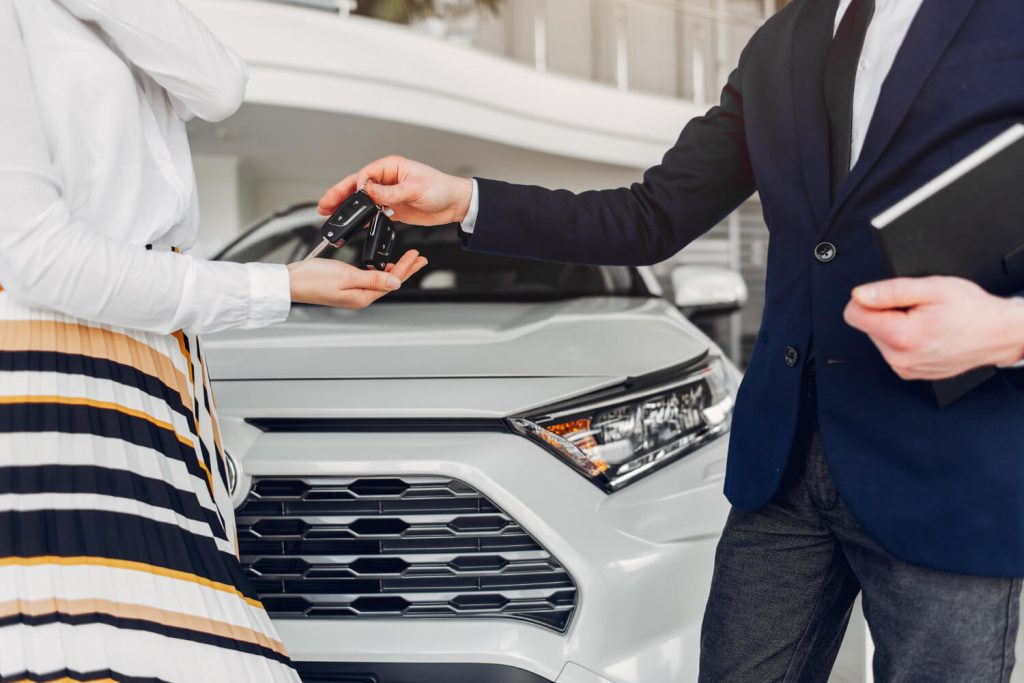
Timing can significantly impact your out-the-door price. The best time to buy a car is typically at month-end, quarter-end, or year-end when sellers are trying to hit quotas. Holiday weekends often feature genuine discounts. New models typically arrive in the fall, making late summer an excellent time for the best deals on outgoing models.
The out-the-door calculation varies depending on your purchase source.
| Dealership Purchase | Private Seller Purchase |
| Includes doc fee and dealer fees | No dealer fees or documentation fees |
| Sales tax collected at purchase | Sales tax paid at DMV |
| Registration handled by dealership | Buyer handles registration paperwork |
| Often includes dealer add-ons | Typically sold as-is |
| May include warranty | No warranty unless factory coverage remains |
| Trade-in can offset sales fee | No trade-in tax advantages |
Purchasing through online retailers can change how your out-the-door price of the car is calculated.
Purchasing new cars at dealer auctions requires a different approach. Most auctions charge buyer’s premiums of 5-10% on top of your bid. You’ll also pay for transportation from the auction site, and registration fees still apply. Without a dealer handling the paperwork, you’ll manage the title and registration transfer and tax payment yourself.
Be alert for common tactics some sellers use to manipulate when negotiating the out-the-door price:
Understanding how each payment method affects your total cost helps you spend money wisely when buying a new vehicle.
| Cash Purchase | Financing |
| No interest costs | May qualify for manufacturer rebates |
| Simpler negotiation | Dealers earn commission on financing |
| No underwater loan risk | Smaller down payment preserves cash flow |
| No monthly payment | Potential tax advantages for business vehicles |
| No early payoff penalties | Build credit history |
Understanding the out-the-door price is essential when buying a new car and searching for ways to buy a used car. This figure includes the selling price plus all other fees. Always negotiate based on the total out-the-door cost rather than monthly payment or MSRP. Request itemized breakdowns from multiple dealerships to compare offers and identify unnecessary fees. Different purchasing methods may affect your deal. Thus, consider utilizing a reliable OTD calculator. By mastering these concepts, you’ll negotiate more effectively and expect to pay fair money for your next car.
Your credit score doesn’t directly affect the vehicle’s out-the-door price. However, it critically affects your monthly payment through interest rates. A higher score can save thousands over the loan term. At the same time, the initial out-the-door cost remains the same regardless of whether you finance or pay cash.
Out-the-door prices can differ substantially between dealerships, even for identical vehicles. These variations occur for several reasons:
Documentation fees vary dramatically between dealerships and states.
Regional tax differences based on seller location.
Dealer-specific add-ons and pre-installed accessories.
Different profit margin expectations at each business.
Inventory supply and demand affecting dealer flexibility.
Manufacturer incentive program participation varies by dealer.
Sellers continue marking up cars above MSRP. This is due to ongoing inventory challenges, particularly for popular models. If consumer demand exceeds supply, dealerships can command premium out-the-door prices. Market-based pricing reflects what buyers are willing to pay. This is not about the manufacturer’s suggested retail price.
Ideally, in most car-buying scenarios, you should pay below MSRP. Nonetheless, for limited-production models or during supply shortages, paying 1-3% over MSRP might be reasonable. Anything beyond 5% over sticker price should be approached with caution and thoroughly researched. Don’t hesitate to determine if the premium is justified by market conditions.
When dealers face poor sales, manufacturers have several approaches to handle excess vehicles:
Offer dealer incentives and consumer rebates to make them more attractive.
Transfer vehicles between sellers to match regional demand.
Sell to rental car companies and corporate fleets at discounted rates.
Export to international markets with different demand patterns.
Use as service loaners at dealerships, then sell as low-mileage used cars.
:format(webp)/vulcan.abetter.bid%2Fwp-content%2Fuploads%2F2022%2F09%2Ffelix-fuchs-PoPsSRju8Y8-unsplash.jpg)
:format(webp)/vulcan.abetter.bid%2Fwp-content%2Fuploads%2F2023%2F10%2Fgetty-images-sWy08yx4Bmo-unsplash.jpg)
:format(webp)/vulcan.abetter.bid%2Fwp-content%2Fuploads%2F2026%2F09%2Fev.jpg)
:format(webp)/vulcan.abetter.bid%2Fwp-content%2Fuploads%2F2026%2F09%2Fflipping.jpg)
:format(webp)/vulcan.abetter.bid%2Fwp-content%2Fuploads%2F2024%2F05%2Froger-starnes-sr-ao4R2_OGLcE-unsplash.jpg)
:format(webp)/vulcan.abetter.bid%2Fwp-content%2Fuploads%2F2026%2F09%2Fcopart.jpg)

