


:format(webp)/vulcan.abetter.bid%2Fwp-content%2Fuploads%2F2026%2F03%2F1abb30.jpg)
 FAQ
FAQ 
:format(webp)/vulcan.abetter.bid%2Fwp-content%2Fuploads%2F2026%2F03%2F1abb4.jpg)
Auto Auction Blog
March 4, 2026
How to Get a Dealer’s License in Florida: A Guide to Start
:format(webp)/vulcan.abetter.bid%2Fwp-content%2Fuploads%2F2022%2F10%2F2022-10-05-11.30.40-150x150.jpg)


Customer Service
9 am - 6 pm EDT
Monday - Friday
International
+1 (302) 613 - 1026Toll-Free
+1 (888) 277 - 3182To get a dealer license in Michigan, you must apply through the Michigan Department of State, meet requirements under the Michigan Vehicle Code, and complete a structured process: choose the correct license type, secure a compliant business location with zoning approval, obtain a $25,000 surety bond and insurance (if required), submit a complete application, pass a licensing inspection, and wait for approval, which typically takes 2–6 weeks.
The law looks at activity. If you flip vehicles for profit, arrange deals for a fee, or build inventory for resale, the state can treat you as a vehicle dealer. The threshold is 5 or more titled vehicles within 12 months. A dealer license for auctions may also be required if your plan includes salvage-only buying. Finding the easiest state to get a dealer license is not the key issue; what matters is whether your activity fits the statute.
A dealer license allows you to:
The Michigan Secretary of State (SOS) is the main regulator. The Michigan Vehicle Code is the controlling statute. The Department of State reviews the application file and investigates the applicant. It can deny or revoke a license for false statements or noncompliance. Local zoning and municipal sign-off must match the exact address before the file can move.
The main legal and regulatory sources are:

A license lets a business operate only within the classification it was granted. A dealer may conduct covered business within the county named on the license. The dealer may also conduct wholesale transactions at another licensed vehicle dealer location in this state. It does not override class limitations.
With the right class, a dealer may:
The limits matter too:
The first real question is simple: will you sell to the public, only to other licensees, or mainly handle parts and salvage? Used vehicle retail typically requires a full lot and posted business hours. Wholesale typically involves a smaller office and no public lane. Class C and Class R or Class H fit dismantling, and late-model parts work better than retail. The Michigan wholesale dealer license fits volume operators who do not want public sales. Not every dealership fits the same license class.
| License Type | Who You Can Sell To | Key Requirements | Typical Startup Cost Range | Restrictions | Best For |
| Class B retail used operation | Public and licensees | Site rules, bond, plates, shop link, training | Higher | Public retail rules | Retail lot |
| Class W wholesaler | Licensed dealers only | Office, posted hours, no public setup | Lower | No public sales; 24 vehicles yearly | Trading |
| Class D arranger | Matched buyers and sellers | Office, records, bond | Mid-range | No retail tie-in | Brokering |
| Class C parts/Class R recycler | Retail or wholesale parts buyers | Parts records, dismantling setup | Variable | Late-model salvage rules are tight | Parts/recycler |
| Class H foreign salvage business | Wholesale salvage or parts activity | Out-of-state base plus state filings | Variable | Not public retail | Cross-state salvage |
State fees are easy to verify. Every class pays the same $160 filing fee. For Class A and Class B, the applicant must purchase at least two plates at $10 each. The other major regulated cost is the $25,000 surety bond. Real startup costs rise with rent and insurance.
State-set and directly related costs include:
The official guidance states that Class A and Class B applicants must apply for at least two plates, and the fee is $10 per plate.
The filing fee is not what ruins a budget. Bigger surprises come from site fixes, insurance wording, and redone local paperwork after a denial. A first dealership learns this after leasing space. If your plan touches salvage cars in Michigan, extra records and agent credentials can push costs even higher.
Check these non-obvious expenses before you sign:
Michigan requires the correct class, an established place of business, local approvals, a complete application file, and, when the class calls for it, bond, plates, training, and insurance requirements. Each requirement is tied to your license class and business model, so the state evaluates them together rather than separately to confirm that your dealership setup matches how you plan to operate.

For retail classes, the site cannot be a residence, tent, or temporary stand. The office must be at least 150 square feet, and the lot needs at least 1,300 square feet for display, plus 650 for customer parking.
The sign has to be permanently attached and visible from the roadway, and regular hours must be posted. Smaller office rules can apply to non-retail classes, but the premises still must be enclosed, functional, and locally approved.
Most problems start with an incomplete file. The packet warns dealer applicants that missing items will delay review. The application requires every needed attachment. Do not operate without a dealer license while the application is pending.
Before you submit the application, make sure you have:
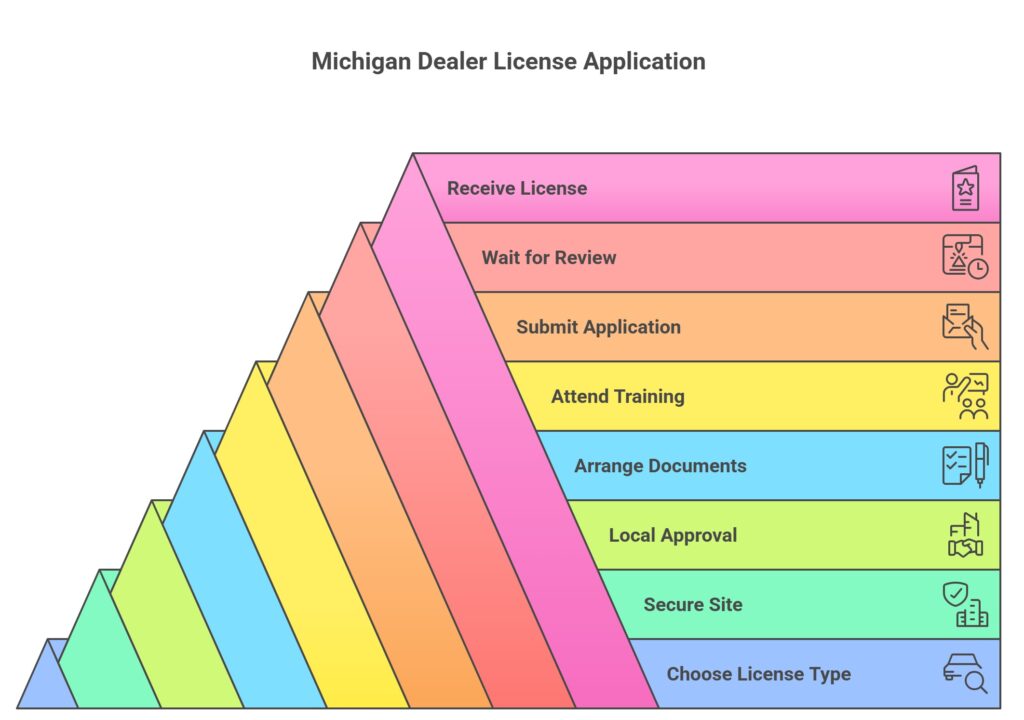
The process must be followed carefully. You need to complete the site work, gather the paperwork, and submit a clean packet before you buy stock. For a Class B dealer, dealer training is part of that path. Complete local approvals first.
Follow these steps:
After the packet arrives, the state reviews the documents and checks the address. A pre-license inspection follows to confirm that the office, lot, sign, and posted hours match the class requested.
If the file is clean and the site matches the application, a new license will be issued. If not, the state usually asks for corrections. A Michigan car dealer who waits to fix defects loses time.
Delays usually stem from the wrong class, missing local approvals, poor bond details, weak insurance wording, or a site that does not really meet the physical requirements. Most delays occur during review checkpoints, where the state pauses processing to verify specific elements of the file, so even small gaps can move an application out of the normal timeline.
Do not restart from zero unless the state tells you to. In most cases, the fastest fix is to match the correction letter item by item and send only what is missing or wrong. Start with the name, address, class, and bond. If inventory descriptions caused confusion, a VIN decoder can help.
Use this order when you correct the file:
Fewer than 5 titled vehicles in 12 months is the usual safe line. At 5 or more, licensing rules apply.
Usually, no for retail. The required site cannot be a residence, tent, temporary stand, or other temporary quarters.
Work with the city or town first, then send the state a fresh, signed approval. The fix may involve hearings, petitions, new plans, or corrected sign details.
Treat it as urgent. The statute lets the surety company cancel on 30 days’ written notice to the Secretary of State, so replace the bond fast.
No direct transfer exists. You still need a Michigan auto dealer license, local address approval, and the full class-specific filing package before you may lawfully operate in the state of Michigan. Renew your license on time.
:format(webp)/vulcan.abetter.bid%2Fwp-content%2Fuploads%2F2026%2F02%2Fcover25.jpg)
:format(webp)/vulcan.abetter.bid%2Fwp-content%2Fuploads%2F2024%2F01%2Fartem-beliaikin-pWe4gf7jajg-unsplash.jpg)
:format(webp)/vulcan.abetter.bid%2Fwp-content%2Fuploads%2F2026%2F09%2Fev.jpg)
:format(webp)/vulcan.abetter.bid%2Fwp-content%2Fuploads%2F2026%2F09%2Fflipping.jpg)
:format(webp)/vulcan.abetter.bid%2Fwp-content%2Fuploads%2F2026%2F09%2Fcopart.jpg)

