


:format(webp)/vulcan.abetter.bid%2Fwp-content%2Fuploads%2F2026%2F02%2Fcover25.jpg)
 FAQ
FAQ 
:format(webp)/vulcan.abetter.bid%2Fwp-content%2Fuploads%2F2024%2F01%2Fartem-beliaikin-pWe4gf7jajg-unsplash.jpg)
Auction Tips
January 17, 2024
How to Buy a Car at Auction Without a Dealer License
:format(webp)/vulcan.abetter.bid%2Fwp-content%2Fuploads%2F2022%2F10%2F2022-10-05-11.30.40-150x150.jpg)


Customer Service
9 am - 6 pm EDT
Monday - Friday
International
+1 (302) 613 - 1026Toll-Free
+1 (888) 277 - 3182To get a Texas dealer license (TxDMV GDN), you must form a business entity, secure a compliant place of business, obtain the required $50,000 surety bond and active insurance, and upload all documents and facility photos through the TxDMV eLICENSING system. Approval is granted only after you pass the official location inspection and all names and addresses match exactly.
Dealer licenses are tied to what you sell and who you sell to. A Texas dealership license must fit your real sourcing and sales plan. Before you get a dealer license, use the dealer manual and choose the license for each type of operation you will run. These different license types include an independent license, a franchise dealer license, and an auction license. If you retail new units, you also need a franchise dealer license. Many auto dealer licenses use similar forms, but each category has its own requirements.
Below, the common types of Texas motor vehicle activity are given; confirm the exact category with TxDMV.
| Category | Type of license | Who it serves | What you can sell | Main requirement verified | Common mismatch |
| GDN retail | Independent license type; vehicle dealer license | Consumers | Used units | Office, sign, defined lot | Name mismatch |
| GDN wholesale | Motor vehicle dealer license | Dealers only | B2B transfers | Office + secure records | Retail ads shown |
| Franchise dealer license | Franchise retail | Consumers | New brand + used | Franchise agreement | Missing brand docs |
| Auction license | Auction operation | Dealers/qualified buyers | Auction lanes | Premises control | Layout issue |
| Salvage-focused | Specialty | Varies | Branded units | Disclosure plan | Storage gaps |
| Converter/mobility | Specialty | Consumers | Modified units | Work docs | Missing process proof |
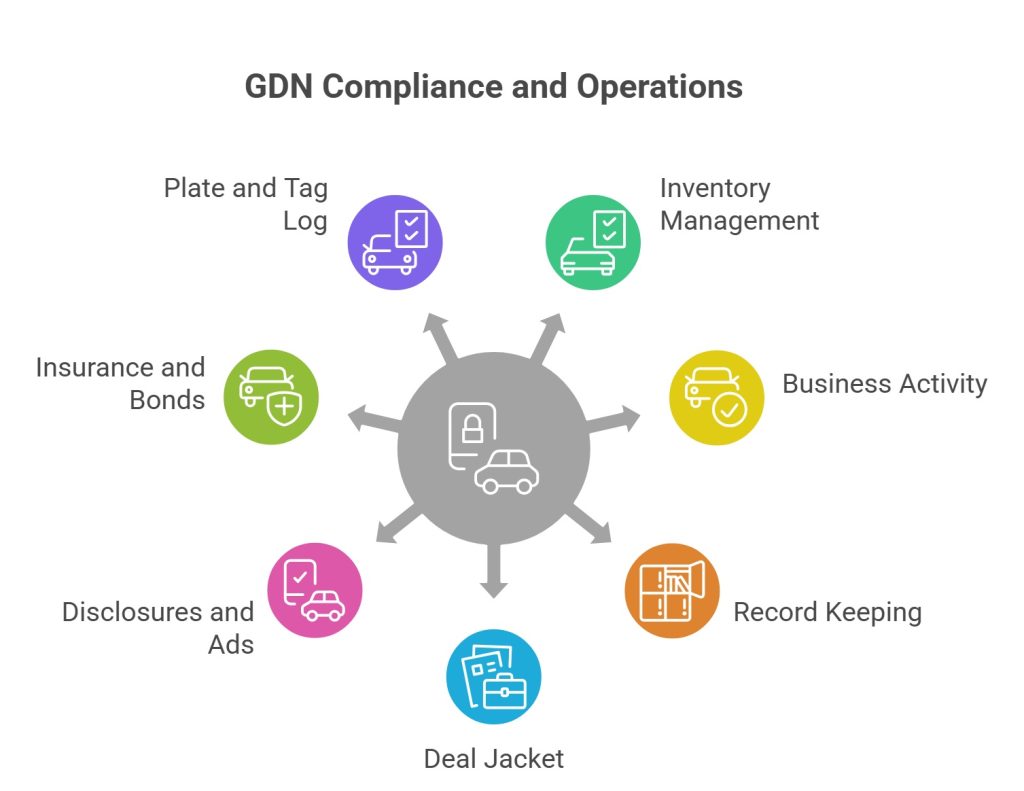
A GDN is the core authorization for an independent motor vehicle dealer. It is a Texas auto dealer license number tied to your approved address and ownership file. The GDN is issued by the Texas licensing unit and sets whether you operate retail, wholesale, or both. Your license allows you to buy inventory, title it correctly, and use plates and tags for business activity. It also requires you to keep records at the licensed site.
For the formal definition and eligibility rules, the TxDMV outlines the Independent GDN requirements on its official licensing page, which includes the application sequence, required documents, and post-approval obligations.
To stay compliant, build your workflow around these actions:
Retail and wholesale dealer licenses look similar, but the limits are different. Retail is built for public sales, while wholesale is built for dealer-only transfers and sourcing cars at dealer auctions. Your facility requirements are usually stricter for retail because the public must be able to find you and receive disclosures at the office. Wholesale can be simpler, but you still need a compliant office and secure records. If you’re deciding how to start a dealership, choose the path that matches your marketing and sourcing plan.
| License Type | Who It Serves | Facility Requirements | Bond & Insurance Levels | Operational Limits | Startup Cost Range |
| Retail | Consumers | Full lot + visible sign + office | $50,000 surety bond; higher limits | Public sales allowed | Medium–high |
| Wholesale | Dealers only | Office + minimal display | $50,000 surety bond; insurance often lower | No public retail; dealer-only transfers | Low–medium |
File your LLC or corporation with the Texas Secretary of State, then keep the formation papers for your application. Your business entity controls who signs and who is screened. If you use a DBA, get a name certificate from the Texas clerk for the name under which the dealer does business. Also, confirm that the legal name and business address match exactly across your LLC documents, lease, insurance, and surety bond, because TxDMV reviewers compare these fields. Save digital copies of all entity records in the same folder you will use for the GDN application, and make sure ownership percentages and managing members are correctly listed.
Vehicle dealer license requirements are enforced through uploads and photo proof. Reviewers compare names, dates, and addresses across every file, so one mismatch can stall the review. For applicants for a Texas dealer license, build a clean folder first, then apply for a license only when it is complete. If you’re a first-time applicant for a Texas packet, don’t miss a photo, and don’t upload the wrong dealer bond form.
Use this checklist before applying for your license:
Your address must meet state place-of-business rules and local zoning regulations, with a dedicated office, sign, and controlled lot. If the city forbids auto sales, approval stops. Before applying, verify the property’s zoning category in writing and confirm that auto sales are an allowed use at that address. TxDMV reviewers also check for a permanent business sign, posted hours, and a workspace suitable for storing records on-site. Under the Texas Administrative Code, specifically §215.140 of Title 43, the TxDMV outlines minimum facility requirements, including office space, display areas, and signage standards that must be met for a dealer license to be issued.
There are 254 counties in the state, so zoning and occupancy rules can vary widely.
A dealership in Texas should have a dedicated office, posted hours, a permanent sign, and control of the premises. A non-compliant site fails when the office is shared, the sign is temporary, or the lot is not defined. Many Texas auto dealers underestimate how strictly “exclusive use” is judged. Another common requirement is separation from unrelated businesses. Use the table below to spot issues early.
| Location setup | Compliant? | Why | Best fix |
| Standalone office + marked lot | Usually yes | Exclusive use | Keep lines, hours, and photos current |
| Home address office | Often no | Local restrictions | Relocate or get written approval |
| Shared suite inside another shop | Often no | Not exclusive | Add locked office + separate sign |
| Parking space only | No | No established place | Lease office + define display area |
| Warehouse + small office | Maybe | Secure for wholesale | Add sign + access plan |

The inspection confirms you can act as a Texas car dealer from the listed address and keep records there. Inspectors compare uploads to the real setup, so quick “props” usually fail. If you handle salvage cars in Texas, organize branded-title disclosures and storage procedures before the visit. The Texas DMV motor vehicle dealer inspector checks that your sign matches your application name exactly.
Follow these steps:
Plan costs in two buckets: setup and monthly overhead. The cost to get approved depends on insurance risk, your surety bond premium, and how much the location needs.
For most applicants, the $50,000 dealer bond costs between $250 and $900 per year, depending on credit. Liability insurance typically ranges from $110 to $350 per month for a small independent dealer. A basic office setup (desk, filing cabinet, internet, and compliant sign) usually runs $600–$2,000 upfront. Leasing a small commercial lot can cost anywhere from $800 to $3,500 per month, depending on the city.
Bond and insurance come first because the state will not issue a license without proof. The surety bond protects buyers if a dealer mishandles titles or funds, and it must stay active while you operate. Insurance pricing changes with drivers and whether you retail. A VIN decoder helps confirm build data before you buy, including when you get a vehicle at auction. Budget for fees too, because the cost of a Texas startup includes auto dealer licenses, plates, and setup items.
| Cost item | What it covers | Planning note |
| Texas auto dealer bond | $50,000 bond filed with the state | Match legal name and address. |
| Surety bond premium | Annual premium to the surety company | Renew before it lapses. |
| Insurance | Garage liability and related coverage | Retail often needs higher limits. |
| Fees and plates | Filing + license plate fees | Depends on license category. |
| Office setup | Desk, files, printer, internet | Inspectors expect a working office. |
| Signage/lot marking | Permanent sign + boundary marking | Temporary banners often fail review. |
Complete the portal forms, upload each file once, and apply for your Texas auto packet only after lease, insurance, and bond details match. If something looks off, contact the Texas Department of Motor Vehicles before resubmitting. When checks and inspections clear, you obtain a Texas license issued by the Texas Department.
Most denials come from inconsistencies, not complicated law. Reviewers want proof of location control, clear photos, active insurance, and a valid bond. A frequent problem is selecting the wrong licenses, especially when the applicant markets to the public but files wholesale. Another issue is missing training proof when a dealer education requirement applies. Finally, shortcuts like buying cars without a dealer’s license can create record issues, and a suspended license can block renewals.
Avoid these common rejection triggers:

After you get a dealer’s license in Texas, it stays active only with clean records, active insurance, and an unbroken surety bond. Operate like a Texas motor vehicle dealer and don’t misuse plates or tags. You must also issue all temporary tags through the state’s eTAG system, keep deal jackets for a minimum of 48 months, and provide every retail buyer with the federally required FTC Buyer’s Guide. Sales tax must be reported to the Texas Comptroller on the schedule assigned to your permit, usually monthly for new dealers.
As an auto dealer in Texas, you must renew your license on time, even if you did not sell many vehicles that year. Put the deadline on your calendar and renew your license early so you don’t lose operating privileges. The DMV motor vehicle dealer manual explains forms, plates, and recordkeeping updates. If you expand, you may need additional licenses or documents, and the requirement list can grow. A dealer training course and a Texas dealer education refresher can help you stay aligned.
To stay renewal-ready, use these habits:
Inspections can happen at licensing, after complaints, and during compliance checks. They’re also common after a location change or when the agency sees repeated title, tag, or record issues.
A dealer submits the buyer’s temporary tag report when issuing a temporary tag through state systems for a retail delivery. Report timing is tied to the sale date and the tag record created.
Yes. Dealer licenses require screening for owners and key personnel. The process uses the background check authorization you upload, plus identity verification and review of prior compliance history.
Licensed dealers collect and remit tax through the account linked to the sales tax permit. Private sellers typically don’t collect sales tax at the sale; the buyer pays tax when titling.
If an independent dealer sells used vehicles to the public, the FTC Used Car Rule generally applies. Dealers must use the Buyer’s Guide disclosure unless a specific exemption fits the transaction.
:format(webp)/vulcan.abetter.bid%2Fwp-content%2Fuploads%2F2025%2F08%2Fgetty-images-dsLmP47anSs-unsplash.jpg)
:format(webp)/vulcan.abetter.bid%2Fwp-content%2Fuploads%2F2026%2F10%2Ffees1.jpg)
:format(webp)/vulcan.abetter.bid%2Fwp-content%2Fuploads%2F2026%2F10%2Flisting9.jpg)
:format(webp)/vulcan.abetter.bid%2Fwp-content%2Fuploads%2F2026%2F09%2Fcopart.jpg)

