


 FAQ
FAQ 
:format(webp)/vulcan.abetter.bid%2Fwp-content%2Fuploads%2F2025%2F11%2Fa-better-bid-vs-autobidmaster.png)
Auto Auction Blog
November 6, 2025
A Better Bid vs AutoBidMaster: Car Auction Platform Showdown
:format(webp)/vulcan.abetter.bid%2Fwp-content%2Fuploads%2F2022%2F10%2F2022-10-05-11.30.40-150x150.jpg)


Customer Service
9 am - 6 pm EDT
Monday - Friday
International
+1 (302) 613 - 1026Toll-Free
+1 (888) 277 - 3182:format(webp)/vulcan.abetter.bid%2Fwp-content%2Fuploads%2F2025%2F12%2Fcopart-vs-manheim-cover-1.png)
Copart vs Manheim are the two dominant salvage auction platforms in the U.S., but they serve different types of buyers and use distinct auction models. Copart offers broad public access through brokers and excels in inventory volume, while Manheim focuses on licensed dealers with stronger inspection services and post-sale protections. Choosing the right platform depends on your goals, whether you’re an exporter, rebuilder, or licensed wholesaler, and how you value price, risk, and ease of access.
Choosing between these car auction platforms reshapes costs, timelines, and inventory quality. A price-driven buyer chasing salvage bargains will favor insurer supply. Retail sellers want strong CRs and arbitration. Rebuilders need repairable cars and predictable transport. Public shoppers prefer simple rules, reliable photos, and clear bidding steps. Match platform strengths to your skills, tool access, and risk tolerance.
| Buyer type | What they value | Copart benefits | Manheim benefits | Watch-outs |
| Retail buyer | Clean titles, quick flips | Budget car finds; huge auction cadence | Retail-ready stock; detailed CRs | Fee stacking; timing windows |
| Rebuilders | Repairable vehicles, parts supply | Deep insurance auto auctions pipeline | Some damage units via trades | Flood/frame risk |
| Dealers | Services, PSA/PSI | Deposit access; simple tools | Financing, recon, arbitration | Higher fees on late-model |
| Exporter | Exportable paperwork | Ports nearby; title courier flow | Clean titles ease customs | Paperwork delays |
| Casual public | Simplicity, safety | App alerts; pre-bidding | Lane guidance at a physical auction | Storage costs, transport gaps |
In many U.S. regions, peak-season wholesale auction prices fluctuate by 10–20%.
Both run massive auction machines, but format shapes your experience. Copart is fully digital, fed by insurance companies, donations, and impounds. Manheim blends lanes and Simulcast, sourcing trade-ins and lease returns. That split affects preview access, CR depth, and arbitration. If you want a retail-tilted venue similar to Copart, Manheim often fits. Deciding between Copart means weighing price flexibility against car condition certainty and service layers.
Copart model highlights:
Manheim model highlights:
Copart allows many public accounts, but some lots require licenses or a broker. Without credentials, you can still bid through authorized agents who handle restricted categories and documents.
Manheim is built for licensed dealers. Certain partners can onboard qualified businesses, but most lanes remain wholesale. Public buyers usually won’t access closed sales, so plan your path before any bidding.
Across major auction sites, Copart’s pipeline is dominated by insurance auto auctions, donations, police tows, and impounds. That means more salvage, total-loss, and theft recovery units. Manheim skews toward late-model trades, lease returns, and closed sales with stronger CR detail. The vehicle’s condition you’ll encounter differs: expect more repairable cars at Copart and more front-line candidates at Manheim. Read flood/frame announcements carefully and compare photos to equipment lists. Your tools, labor, and budget must fit the car you choose.
| Category | Copart typical | Manheim typical |
| Titles | Salvage, non-repairable, some clean | Mostly clean with announcements |
| Mechanicals | From non-runners to Run & Drive cars | More running units; tighter CRs |
| Cosmetics | Collision, hail, theft, and natural disasters | Light recon, retail-friendly |
| Sources | Insurer pipeline, donation, municipal | Dealer, captive finance, fleet |
| Types of vehicles | Car, motorcycle, trucks, SUVs | Car, SUVs, trucks, and commercial |
Manheim’s clean-title share is typically higher, while Copart carries more disclosed damage units.
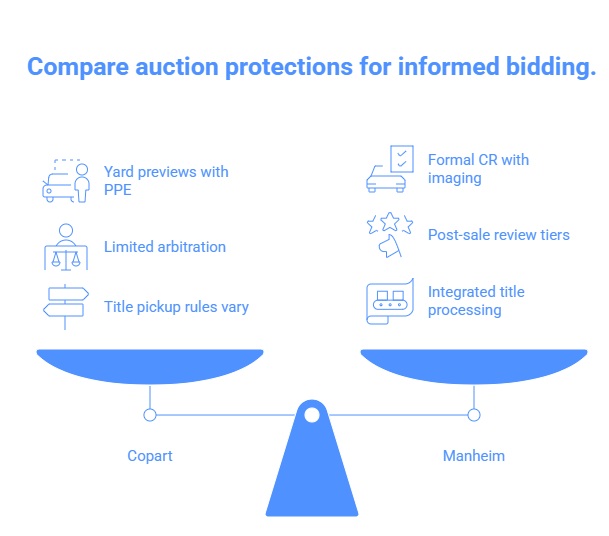
No auction replaces diligence. Copart permits yard previews with PPE; third-party reviews vary by location. Manheim emphasizes standardized CRs, frame/OBD checks, and PSI tiers. Use a VIN decoder to verify options and match equipment to the car identification number shown. Confirm odometer, announcements, and photos before any remote bidding. If you’re shipping overseas, ensure titles are released and correct prior to port delivery.
Copart reviews & protections:
Manheim reviews & protections:
Hammer is only the starting line. Add buyer fees, internet/Simulcast, yard/gate, broker, taxes, recon, storage costs, transport, and time. Beyond those line‑item charges, each platform has its own cost behavior that can swing your final total by hundreds or even thousands of dollars. When you factor in repair parts, labor, carrier scheduling, and any broker charges needed to access restricted lanes, the hammer price becomes just one piece of a much larger financial picture.
Fee math differs by auction event, state, and membership. Copart uses tiered buyer premiums plus internet and release charges. Manheim layers buy fees, Simulcast, PSI, and recon. Export adds courier and customs. Always model total cost: hammer + fees + logistics + recon. If a license is required, include the broker charge up front.
| Fee element | Copart (typical) | Manheim (typical) | Notes |
| Membership/deposit | Public to Premier, deposit-based | Wholesale account setup | Impacts limits |
| Buyer fee | Tiered by hammer and site | Tiered by hammer | Use calculators |
| Internet/Simulcast | Per online sale | Simulcast line item | Event-specific |
| Gate/Yard | Per-lot release | Yard/processing fee | Pickup timing |
| Storage | Daily after grace | Daily after grace | Weekends add risk |
| Documentation | Title/courier | Title/courier/PSI | Export paperwork |
Missed add-on costs can swing outcomes by 8–15%.
Both platforms share the same arc: research, bidding, payment, paperwork, pickup, and delivery. Copart moves quickly; Manheim mirrors lane cadence. Before paying, re-check announcements and invoices. For public access to restricted lots, the best Copart broker can handle licenses and paperwork. Verify the title, VIN, and names before releasing to a carrier.
Copart buying workflow:
Manheim buying workflow:
Branding controls legality and value. Salvage, rebuilt, and non-repairable influence registration and export options. Insurance companies and an insurer must endorse correctly. After natural disasters, flood branding spikes, and the auction industry tightens disclosures. Export requires exact matches between the title, the car’s ID, and the manifest. Read announcements for frame, theft, and total loss. Smart choices begin with correct documents and timelines.
For example, according to the California DMV, branded titles, such as salvage, rebuilt, or junk, are assigned to vehicles that have been declared a total loss or suffered major damage, and they directly impact both registration eligibility and required disclosures.
| Issue | Why it matters | Copart tendency | Manheim tendency |
| Title status | Determines registration/export | More branded titles, salvage heavy | More clean titles overall |
| Announcements | Flood/frame/odometer/theft | Frequent damage disclosures | CR-driven detail |
| Paperwork | Endorsements & courier | Yard-level timing variance | Central coordination |
| Export | Manifest must match VIN | Strong exporter networks | Common but stricter |
| Legal windows | Arbitration limits | Narrower windows | PSI/arbitration layers |

Both can work well for global buyers. Copart aligns with parts markets and labor-rich regions where salvage vehicle projects are viable. Manheim’s clean titles and CRs simplify customs and pre-delivery steps. If your goal is budget car sourcing for rebuild, Copart is strong. If you want retail-ready late-model cars, Manheim often feels more plug-and-play.
Plan invoice, title a courier, and port booking early. Choose carriers familiar with yard release rules. Experienced export buyers coordinate drayage and cutoffs to minimize dwell. Align HS codes and consignee details before sailing; delays trigger storage costs and missed vessels.
Sentiment tracks use cases. Copart fans highlight extensive inventory and pricing. Manheim earns praise for CR accuracy and PSI. Complaints target add-on fees and yard queues. Local execution matters by site and lane. These insights are based on user feedback from various online sources and do not represent our own evaluations.
Users like the app, alerts, and volume. Parts hunters love the salvage auction depth and storm recovery listings. Exporters cite yard proximity to ports. Critics mention “as-is” risk and photo variance. Better outcomes come from thorough reviews, careful bidding, and carrier scheduling.
Wholesale users value CRs and PSI for fewer surprises. Recon shortens the time-to-line for a used car. Prices can run higher, but units arrive closer to retail-ready. Some dislike fee creep and Simulcast jumps. Reading CRs and minding windows is essential.
Failures often start with skipping reviews, misreading titles, or ignoring logistics. Overconfidence in photos hides flood or frame clues. Export stalls when manifests don’t match the car’s ID on the title. Model total cost, not just hammer, and compare comps by condition and announced issues. According to the Utah DMV, vehicles with branded titles (like salvage or rebuilt) must be clearly disclosed before sale. Failure to review these details can lead to costly mistakes or registration denial. Use tools and verified data before you bid.
| Mistake | Why it hurts | Prevention |
| Ignoring announcements | Hidden damage kills margins | Read disclosures before bidding |
| Overpaying for damage | Repairs exceed value | Cap bids; map parts & labor |
| Skipping preview | Miss flood/frame clues | Hire inspection; bring PPE |
| Title mismatches | Export or DMV rejection | Verify names, car’s ID, lien status |
| Forgetting logistics | Costs eat profit | Book carriers early; track storage fees |
Full CRs correlate with roughly 30% fewer arbitration cases than photo-only listings.
Copart and Manheim anchor the auto auction ecosystem, but serve different paths. Copart excels at salvage and bargain sourcing; Manheim shines for retail-ready selection. Your choice depends on skills, tooling, and risks. Budget fees and logistics, verify documents, and plan transport. For parts or rebuilds, Copart is compelling; for front-line retail, Manheim often feels smoother. Used wisely, either platform can be the best fit for your goals.
Yes. Both require deposits or funding limits to bid in online auto auctions. Copart’s is refundable; Manheim ties limits to wholesale credentials and account standing.
Often. High supply and demand converge, and intense auction participation can lift late-model car and SUV prices during seasonal peaks.
They list varied assets, but the fit differs. Copart leans to damaged powersports, including motorcycle units; Manheim trends retail-ready. Budget specialty transport for each car or motorcycle.
Yes. Manheim provides reconditioning tiers to deliver well-maintained cars, helping frontline prep and presentation.
Carriers’ policies govern claims. Document everything on arrival.
– Photograph the car at pickup and delivery.
– Note issues on the bill of lading immediately.
– File a claim with the carrier and the auction promptly.
– Use insured, bonded transport partners.
:format(webp)/vulcan.abetter.bid%2Fwp-content%2Fuploads%2F2025%2F10%2Fcopart-vs-a-better-bid.png)
:format(webp)/vulcan.abetter.bid%2Fwp-content%2Fuploads%2F2025%2F11%2Fautobidmaster-vs-copart-1.png)
:format(webp)/vulcan.abetter.bid%2Fwp-content%2Fuploads%2F2026%2F10%2Ffees1.jpg)
:format(webp)/vulcan.abetter.bid%2Fwp-content%2Fuploads%2F2026%2F10%2Flisting9.jpg)
:format(webp)/vulcan.abetter.bid%2Fwp-content%2Fuploads%2F2026%2F09%2Fcopart.jpg)

